Five things the Social Mobility Business Seminar told us about the year ahead
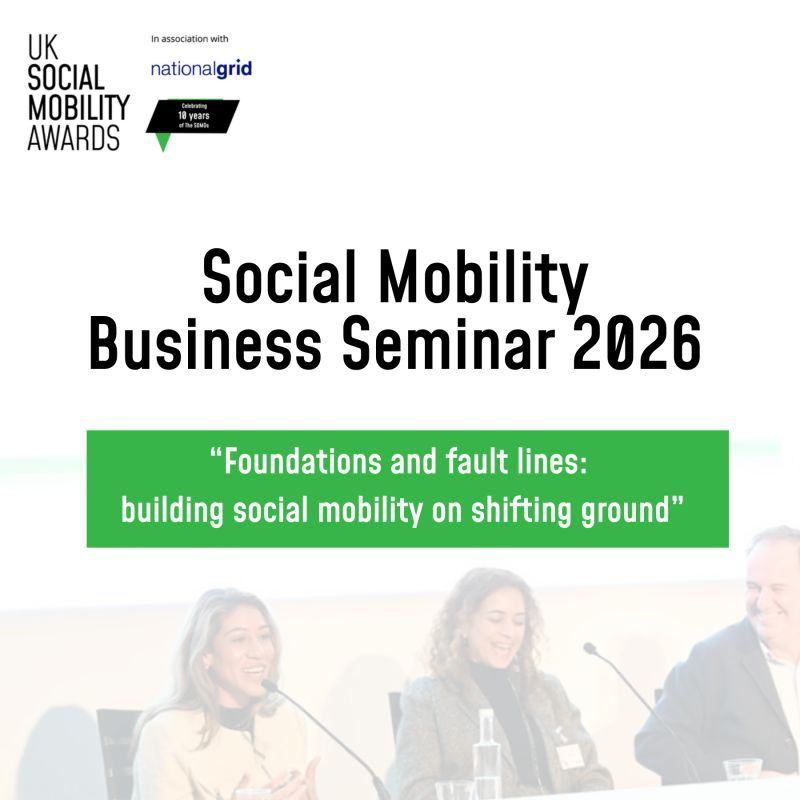
Uptree CEO Oby Bamidele recently attended the 9th annual seminar on April 22nd and here were her biggest takeaways:
Every year, the Social Mobility Business Seminar brings together the people who are actually trying to move the dial: early careers leads, DEI practitioners, employers, policymakers and social sector organisations. This year's theme was "Foundations and Fault Lines: Building Social Mobility on Shifting Ground," chaired by Tunde Banjoko OBE, founder and CEO of Making the Leap.
Nine years in, the conversation has matured. There is less scene-setting, less justifying why this work matters, and more honest reckoning with where it is falling short. Two threads ran through almost every session: a growing impatience with activity as a proxy for progress, and the recognition that AI is already reshaping access to opportunity rather than waiting in the wings as a future concern.
Here is what stood out, and what it means for early careers professionals heading into the rest of 2026.
The 41-point gap that stopped the room.
The sharpest moment of the day came from new research presented by Nina Slingsby, analysing over 100 organisations that entered the 2025 UK Social Mobility Awards, including all 14 winners.
The headline finding: 94% of employers are running early careers outreach, including work experience, career fairs and employability programmes. Only 53% are actively recruiting from lower socioeconomic backgrounds.
That 41 point gap between reach and hire is the clearest articulation yet of where the sector is currently stuck: employers invest in reaching young people, run the events, check the boxes. And then the hiring process quietly filters them back out.
For early careers professionals, this finding reframes the central challenge. The question is no longer whether you are doing enough outreach. It is whether your outreach is connected to your hiring. The two are often run by different teams, measured on different metrics, and reported to different parts of the business. Until they are joined up, the gap will persist regardless of how many events you run or how many students you reach.
Nina's practical recommendations for employers were specific. Tailor outreach to help young people from less advantaged backgrounds build the skills that your hiring process will test, including tech, AI, business and soft skills. Invite outreach participants onto a mailing list for relevant opportunities before they are published more widely. Offer genuinely supportive pathways from outreach to application, including sharing interview formats in advance and providing pre-assessment coaching. And as AI changes the shape of entry-level roles, maintain entry-level recruitment rather than allowing it to be quietly replaced.
The NEET population now exceeds one million, with young people from less advantaged backgrounds disproportionately represented. That number is rising even as employers face cost pressures, AI disruption and geopolitical uncertainty. Nina's argument was that the case for action has grown stronger as a result, not weaker.
Inclusion and competitiveness are now the same argument
Darren Hardman, CEO of Microsoft UK and Ireland, opened his keynote with a framing that is worth carrying into every internal conversation you have about early careers budgets this year.
In an AI economy, unused talent is not just unfair. It is economically inefficient.
His argument was that AI will change not only the jobs themselves but the pathways into them, and that whether AI expands or concentrates opportunity will depend on deliberate employer choices rather than on the technology itself. Youth unemployment currently sits at 16%. Microsoft has supported 1.5 million people across the UK to build AI skills in the past year through programmes including the government's Tech First and AI Skills Boost initiatives, and has committed 500 placements and 5,000 volunteering hours through TechFirst.
His three proposed shifts for employers were concrete. First, treat skills rather than credentials or background as the foundation of opportunity. Second, rethink hiring toward potential and support progression once people are in, not just at the point of entry. Third, move from activity measurement to outcome measurement throughout the early careers funnel.
That third shift is the one most likely to require structural change for early careers teams. Measuring how many students attended an event is straightforward. Measuring whether attending that event changed their trajectory is a different kind of problem altogether, and one that most organisations have not yet solved.
AI is creating a new access divide inside your outreach
This was the panel moment that generated the most discussion, and it deserves more attention than it typically gets.
Joanne from DLA Piper, drawing on doctoral research across 45 partners in the UK, raised a new form of access divide that is already affecting outcomes. Some young people are being screened out of applications because they are using AI in a basic copy-and-paste way. Those with more cultural capital already know how to use AI to enhance and strengthen their work.
The divide is not about whether young people have access to AI tools. Most do. It is about whether they have been taught to use them well, critically and strategically rather than as a shortcut. That knowledge currently sits disproportionately with those who already have more advantages.
Craig from National Grid built on this with Darren Hardman's earlier framing: it is not AI that takes your job, but the person who can use AI and communicate its value to the business.
The implication for outreach design is direct. If your programme is not explicitly developing AI literacy alongside employability skills, it may be inadvertently widening the gap it was built to close. Young people who arrive at an assessment centre knowing how to use AI well will outperform those who do not, regardless of their underlying potential. That is a design problem, and it is one early careers professionals can act on now.
The sector is moving from pathways to place
Rob Wilson, Deputy Chair of the Social Mobility Commission, set out a meaningful shift in how the Commission is now thinking about mobility.
The Commission is moving away from elite pathway thinking and EDI-framed social mobility toward what it is calling "rooted mobility." The focus is on regional disparities, devolution and helping people thrive where they already are rather than having to escape somewhere else to get on.
The investment data makes the case for why this shift matters. Nearly half of all UK private investment last year went to London. Another quarter went to the South and South East. Adult learning has fallen by almost a quarter over the last decade. The Commission's recent report "Innovation, Investment, and Inclusion" calls for every region to develop a long-term strategic growth plan led by business and backed by government, for the New Enterprise Allowance to be revived for those on Universal Credit, and for apprenticeships to be simplified and made more accessible to small firms.
For early careers professionals working outside London, this framing is useful. It reframes your work not as a regional version of a London-centric programme but as a response to a structural inequity in where opportunity is built. And for those making the internal case for investment in regions, Wilson's data provides the external anchor you need.
Tough times reveal what organisations actually believe
John from Howard Kennedy made the point that may prove most useful when budgets come under pressure later in the year.
Tough times reveal what organisations actually believe. If social mobility is treated as a nice-to-have, it becomes a casualty when costs rise or headcount freezes. If it is framed as an economic necessity, it gets protected.
He also noted something worth flagging for anyone navigating internal politics right now: social mobility currently feels less politically contested than other DEI areas. That may create a window for organisations to act, invest and build without being pulled into more polarised debates. It is a window that may not stay open indefinitely.
Craig from National Grid reinforced this from a workforce planning angle. National Grid alone needs 55,000 new hires this decade, against an industry-wide need of 117,000. His framing was direct: the UK does not have a skills shortage, it has an access shortage, and unblocking that access makes hard-to-fill roles easier to recruit. Social mobility is not a charity programme. For organisations with long-term workforce needs, it is the strategy.
On running internal social mobility networks effectively, the consistent message from the Q&A was to set a small number of clear objectives per year, link sponsor KPIs to personal performance metrics so people can actually carve out time, and frame networks as a business opportunity open to everyone rather than a fix for an underrepresented group.
The through line: from activity to outcomes
Almost every speaker used some version of the same phrase. Activity to outcomes. It came up in the keynote, in the panel discussions and in the Q&A. The sector is converging on outcome measurement as the next real test of credibility, and the organisations that can demonstrate progression, not just participation, will be better placed for whatever comes next.
That includes being able to put a credible number on the social value your early careers programme creates. Not just for ESG reporting, though that matters. But because without it, every conversation about budget, about renewal and about whether this work is worth continuing happens without the most important evidence in the room.
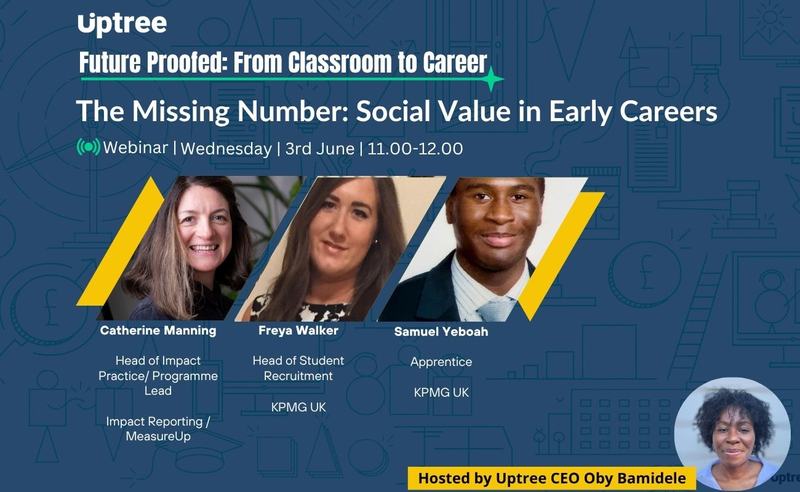
That is the question we are taking into our next event. On 3 June, Uptree is hosting The Missing Number: Social Value in Early Careers, a webinar exploring how organisations can build a credible, evidence-based figure for the value their early careers programme generates. We will be joined by Catherine Manning of MeasureUp / Impact Reporting and Freya Walker, Head of Student Recruitment at KPMG, who has been doing exactly this work internally: making the case that early careers is worth more than hire conversion rates alone.
If your organisation is trying to answer the same question, we would like you in the room.
[Register here]
Wednesday 3 June, 11am–12pm. Free to attend.
By Uptree
Published on:
Mon 11 May 2026