
One million young people are NEET. The Milburn Report says employers need to act.
The UK's NEET crisis costs the economy an estimated £125 billion every year. Nearly one million young people are currently not in education, employment or training - and according to the newly published 2026 Milburn Report, the NEET rate has "barely crept below 10%" in 25 years (Young people and work: interim report, 2026).
While this sounds stark, this is an issue we’ve been acutely aware of at Uptree since being founded in 2015. Just in Uptree’s lifetime there have been several waves of policy aimed at solving this issue in both the private and public sectors. While they have had their successes, they have not fundamentally changed the underlying NEET issue with young people in the UK.
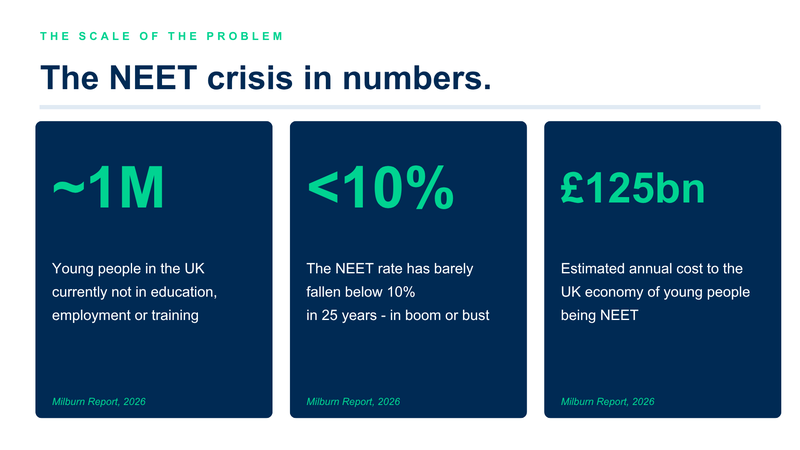
The NEET crisis in the UK: what the data shows
The costs of becoming NEET after education are significant and long-lasting, with the Milburn Report highlighting that young people who are NEET experience “a long-term scarring effect” on their income even if they re-enter the workforce later in life.
For the wider economy, the report also estimates an annual cost to the UK of £125 billion.
This is a structural problem - one that has embedded itself across education, employment and the transition between the two. It will not be solved from one direction alone. But through targeted action and genuine partnerships, every employer in the UK has a role to play.
The work experience gap
"Careers guidance has improved, but remains too unequal. Work experience is too often an afterthought. The young people who most need exposure to work are the least likely to receive it." (Young people and work: interim report, 2026).
Access to employers and workplaces remains a barrier, with access not reaching the young people who need it most. The report echoes what we’ve always known at Uptree - that a lack of support for careers services often results in access to work experience being restricted by who a young person’s parents know. A young person’s ability to access the world of work should not be limited by their family background or network.
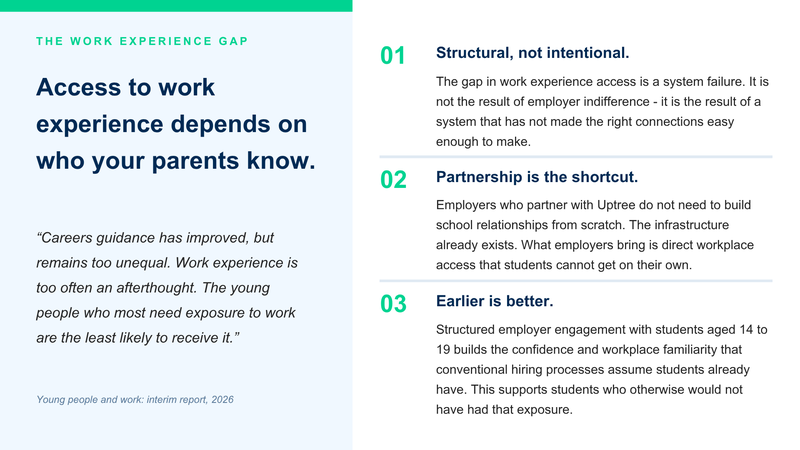
Employers who partner with Uptree help bridge that gap - creating access that does not require a network first. Getting students in front of real workplaces, early and consistently, can fundamentally change what a young person believes is possible for them.
Employers who partner with Uptree help bridge that gap - creating access that does not require a network first. Getting students in front of real workplaces, early and consistently, can fundamentally change what a young person believes is possible for them.
Structured, meaningful employer engagement while students are still in school (especially for those from lower socioeconomic backgrounds) can unlock doors for students who otherwise would not have had access.
Work experience should not be an afterthought, it needs to be designed into the foundations of talent attraction and community engagement. Ensuring students aged 14-19 can access work experience enables students to gain confidence, skills, and knowledge while they are making decisions about their futures.
Many employers are enthusiastic. We need to turn that into impact.
The Milburn Report highlights an "overwhelming enthusiasm to do more to address the NEET crisis" from employers. It also captures something that many employers will recognise honestly in themselves: a concern that students arriving are less work-ready, struggling with anxiety and low confidence, and that the pastoral burden of supporting them is growing.
To have the greatest impact on students at risk of becoming NEET, employers need to look beyond the “ideal” candidate: the young person from a lower socioeconomic background who already has the strong grades, the work experience, and the confidence to perform well in an interview. These criteria mean that every employer in the country is looking for the same people and not enabling the greatest access.
To see real structural change, the shift needs to be from looking for polish to looking for potential. The employers who will make the biggest difference are those willing to invest in potential early, through structured engagement, before the application window opens.
“Recruitment has become more remote, more automated and less human . . . Apprenticeship starts for young people have declined by over 40%. In other words, the first rungs on the old career ladder have weakened.” (Young people and work: interim report, 2026).
These shifts highlighted in the Milburn Report have made the journey into work harder for young people, particularly those without existing networks or polished applications. The employers who recognise that and act to change it, by engaging earlier, assessing differently, and partnering with organisations that already have the school relationships and community trust to reach those young people, are the ones who will build the most genuinely diverse and work-ready early careers pipelines.
What employers can do to tackle the NEET rate
Uptree has spent over a decade working to support young people, schools, and employers. The Milburn Report confirms what our experience has always told us - solutions to the NEET crisis need to work on two levels.
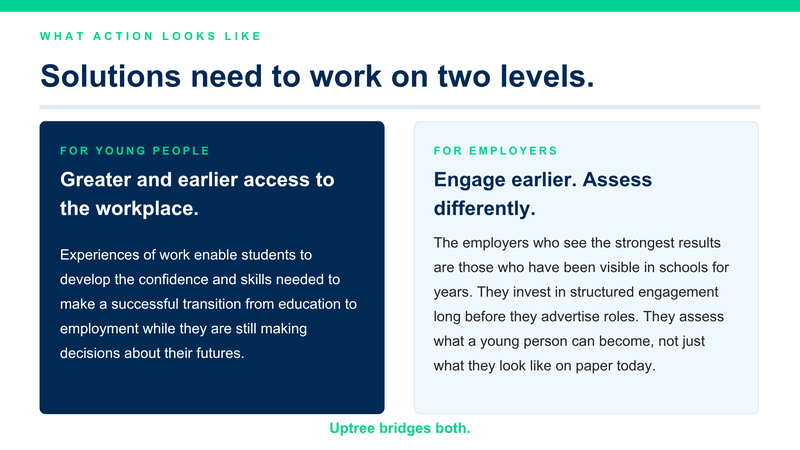
- For young people, it means greater and earlier access to the workplace. Experiences of work enable students to develop the confidence and skills needed to make a successful transition from education to employment.
- For employers, it means engaging with talent pipelines sooner. Employers who see the strongest results will be the employers who have been visible in schools for years, who have invested in structured engagement long before advertising roles, and who have made a deliberate decision to assess what a young person can become, not just what they look like on paper today.
That is not a small ask. It is, however, a necessary one. None of it has to be done alone.
What can employers do?
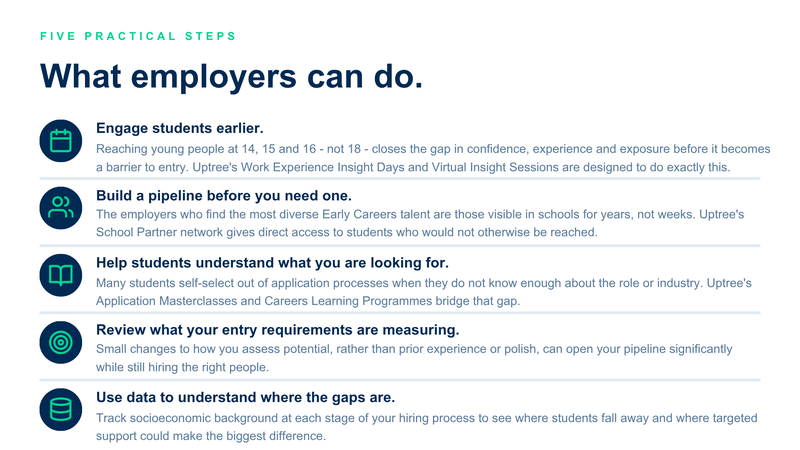
- Engage students earlier. Reaching young people at 14, 15 and 16 - not 18 - closes the gap in confidence, experience and exposure before it becomes a barrier to entry.
- Build a pipeline before you need one. The employers who find the most diverse Early Careers talent are those who have been visible in schools for years, not weeks.
- Help students understand what you are looking for. Many students will self-select themselves out of your application processes when they do not feel they know enough about the role, the industry, or what they need to do to be successful in the hiring process.
- Review what your entry requirements are actually measuring. Small changes to how you assess potential, rather than prior experience or polish, can open your pipeline significantly while still ensuring you hire the right people for the job.
- Use data to understand where the gaps are. Tracking socioeconomic background at each stage of your hiring process shows you where students are falling away and where targeted support could make the biggest difference.
Uptree: built for this
Uptree connects students aged 14 to 19 from schools in areas of high socioeconomic deprivation with employers through Work Experience Insight Days, Virtual Insight Sessions and school engagement programmes. Our partnerships are structured and skills-focused - designed to build the professional confidence, aspiration and workplace readiness that conventional hiring processes assume students already have.
Employers who work with Uptree are not ticking a box. They are building a pipeline of genuinely diverse, high-potential young people who know their organisation, understand their industry and are ready to apply when the moment comes.
The Milburn Report confirms what we see every day: the ambition is there. 84% of young people who are NEET say they want to find a job, education or training. Young people have not given up. The question is whether employers are willing to meet them - not just in principle, but in practice.
Ready to move from intention to action?
Social Mobility Day is an invitation to start a new chapter. But writing a story you can be proud of takes decisions, not just ideas.
If your organisation is ready to build an early careers pipeline that is genuinely inclusive from the ground up, we would love to talk. Book a discovery call or email us at info@uptree.co.
By Uptree
Published on:
Wed 10 Jun 2026