The Missing Number - Social Value in Early Careers - Webinar Recap
June 2026 | Future Proofed: From Classroom to Career Webinar
There is a quote that stayed with us after this session. Not from a philosopher or a politician - from the slide deck of a procurement policy document:
'Are we making as much positive impact as we can, as quickly as we can, with the resources we have available?'
It is a simple question. But for anyone working in early careers, it has a complicated answer.
Interestingly we also included a live poll asking: has anyone outside early careers ever asked you to prove the social value of your programme?
46% said not yet, but they expected it soon. 23% said yes, and they struggled to answer. 6% said yes, and they just made something up.
This was exactly why our latest Future Proofed webinar focused on: The Missing Number - Social Value in Early Careers. We brought together four people who are actively working to change the way impact gets measured, reported and valued in the early careers space.
Here is what came out of it.
Watch the webinar
You can also download the presentation deck below.
Who was in the room?
Catherine Manning, Head of Impact Practice / Programme Lead - Impact Reporting / MeasureUp
Catherine opened the session with a deceptively simple question: what actually is social value? Her answer - the changes we create in people's lives, both positive and negative, intended and unintended - set the tone for an honest conversation about why measurement in early careers has been so hard to get right.
Freya Walker, Head of Student Recruitment - KPMG UK
Freya brought the employer perspective, walking through how KPMG approaches social value not as a reporting exercise but as something woven into how their early careers, corporate responsibility and inclusion teams work together. Collaboration, she argued, is not optional if you want impact to be real.
Hannah Scott, Data and Impact Manager - Uptree
Hannah shared Uptree's own journey with social value measurement - including the numbers that came out of applying the MeasureUp framework to Uptree's employer partnerships in 2024/25.
Oby Bamidele, CEO - Uptree
Oby anchored the session in the bigger picture: the outreach-to-hiring gap, the policy context, and the fundamental question of whether the sector is moving fast enough to make the impact it knows is possible.
Why this matters now
The context is shifting. Three forces are converging that are making social value measurement in early careers an urgent issue rather than a nice-to-have.
The first is procurement. The Social Value Model and PPN 002 now mandate a minimum 10 per cent social value weighting in central government contracts. Bid teams are increasingly turning to early careers colleagues and asking for a pound value. Most find it difficult to produce one accurately.
The second is ESG reporting. Reporting expectations have expanded well beyond diversity headcount figures. Skills, access and social mobility are now part of what stakeholders expect organisations to account for.
The third is the outreach-to-hiring gap. Whilst 94 per cent of employers run outreach programmes, only 53 per cent are actively recruiting from lower socioeconomic backgrounds. That is a 41-point gap.
As Oby put it:
"If early careers teams cannot show to procurement, finance teams and senior leadership what their outreach is producing in monetised, comparable terms, then outreach can just be seen as a standalone CSR activity rather than a strategic talent investment."
What social value actually means
Catherine was clear that the term itself is part of the problem. "It's one of those terms that gets bandied around, and there are still lots of different definitions if you look at different documents." Her working definition - drawn from Social Value International and aligned to the HM Treasury Green Book - is that social value is about the things that affect our quality of life and overall wellbeing, and about our inequality of access to those things. The value of outcomes from the perspective of the people experiencing them, not the organisation delivering them.
From there she was direct about where most early careers teams get stuck: waiting until everything is perfect before starting.
"Don't be put off by the expert part of the practice that makes it seem too difficult. Have a go. The UK has a really well-developed national framework of wellbeing dimensions through the ONS, openly available methodologies through the Green Book, and lots of guidance and resources that can support us with having a go."
Her practical framework is layered: estimate when you need to, measure what you can, and evidence when it matters. MeasureUp mirrors this through Bronze, Silver and Gold levels - Bronze being proxy-based estimation, Silver adding context and segmentation, Gold introducing actual evidence from the people experiencing the change.
The numbers behind Uptree's work
One of the most striking moments in the session was the reveal of Uptree's own social value data, calculated using the MeasureUp framework at Bronze level and matched against the relevant impact pathway values.
For Work Experience Insight Days, the activity was mapped straightforwardly: students attending an in-person event at an employer's workplace, developing skills, learning about career pathways, networking with employees. The outcomes - increased confidence, increased ambition, improved workplace skills, more informed decisions about next steps - were matched against the MeasureUp value WWD4: Engaging in Youth Activities, which generated a base value of £1,550 per student at Bronze level.
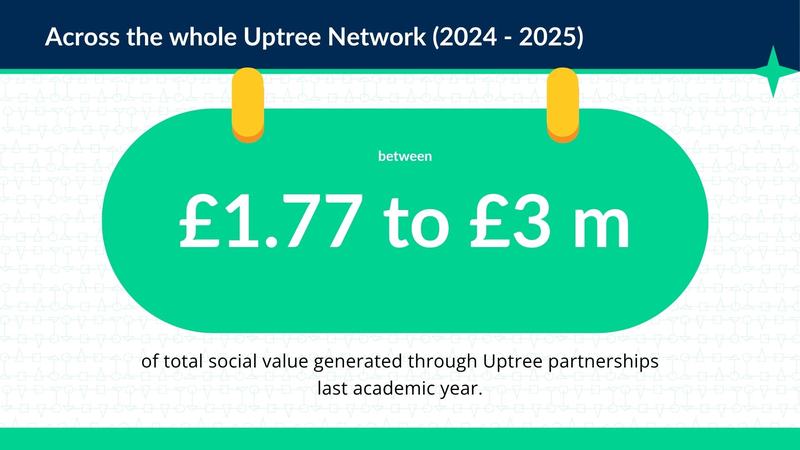
Across all activity types, the total social value generated through Uptree's employer partnerships in 2024/25 was between £1.77m and £3m. For every £1 invested by employers, between £1.87 and £3.16 was generated in social value.
Breaking it down:
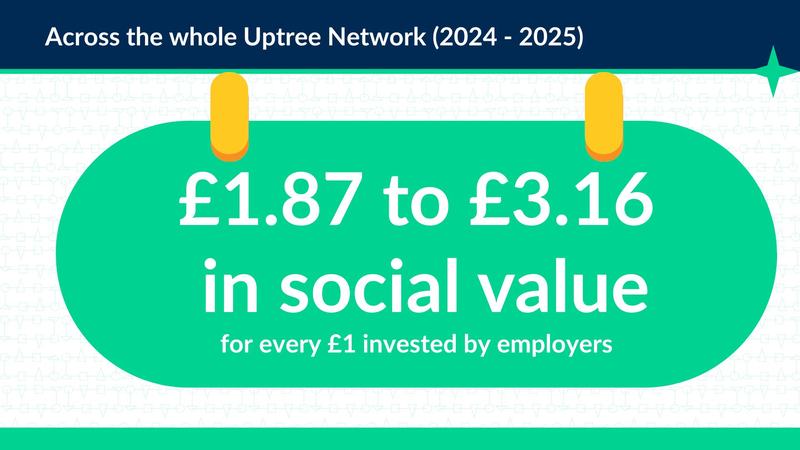
- Work Experience Insight Days (in-person): £170 to £227 per attendee, or £9,638 to £12,851 per event
- Virtual Insight Sessions: £62 to £83 per attendee, or £6,680 to £8,907 per event
- Student Success (apprenticeships, early careers roles, internships, longer placements): between £1.2m and £2.3m
- Employee Volunteering: between £43,738 and £58,317
Hannah flagged something important about the virtual versus in-person distinction:
"Virtual events generate a lower social value per person because they're shorter, but they're able to reach a broader number of young people - so they can often generate the same, if not more, social value in a single event due to that breadth of reach. In-person events tend to generate more value per attendee because of that longer, deeper one-on-one connection. You get breadth and depth. Combining both is when you're really getting the maximum reach."
Oby added what landed hardest for her personally during the process: "Going through the MeasureUp framework really opened my eyes to how holistic wellbeing actually is. When we measure a young person's confidence, their aspiration, their commercial awareness, their knowledge of the labour market - we are actually measuring their ability to transition from education to employment. And that in a sense is wellbeing."
About MeasureUp
Catherine Manning is Head of Impact Practice at Impact Reporting, and one of the architects behind MeasureUp - a free, open, transparent measurement and valuation framework designed to offer a credible alternative to the patchwork of social value tools that currently exist.
The framework is built around a layered approach: estimate when you need to, measure what you can, and evidence when it matters. It is not asking for perfection. It is asking for progress.
MeasureUp is structured around three levels: Bronze (proxy-based estimation), Silver (segmented and contextualised measurement) and Gold (real-world evidence). For most early careers teams, Bronze is the accessible, achievable starting point.
The relevant MeasureUp values for early careers work include:
- WWD2: Volunteering regularly
- WWD4: Engaging in Youth Activities
- ES3: Young Persons Wellbeing Programme
- ES1.1: Being on an Apprenticeship
- ES2.2: Being on a Traineeship
How KPMG approaches social value
Freya was candid about where KPMG started: "We were very much seen in the early careers side as: you are just a hiring tool. Before, it was very much a case of early careers and student recruitment sat at one side, and our social value and CR team sat on a very opposite end - with different objectives, different metrics and different reporting lines."
The deliberate move over the last few years has been to collapse that separation.
"We've made a real move to be a little bit more collaborative - really aligning on those shared outcomes, embedding that collaboration within the programmes we run, and then using combined data to demonstrate that to leadership, procurement and the client side."
KPMG's suite of activity spans the Opening Doors campaign - a flagship programme aiming to support one million young people to build core skills by 2030, having already reached over 800,000 since 2023 - through to formal work experience programmes, digital experiences and partner-led insight days, four of which run annually with Uptree across the UK.
One of those programmes is One+1 done with Uptree. For every young person KPMG brings in through their own networks, they match them with one student from Uptree's network who would not otherwise have had that access.
Freya explained what drove it: "We know that within the UK, the number of advertised formal internships and work placement opportunities has fallen by 30% since 2022. We saw a real desire from our business to say - people are bringing personal contacts in, but how do we ensure equal access? You will bring someone in, and you need to also bring someone from a lower socioeconomic background to give them the same experience." Over five to six years, around 1,500 people from lower socioeconomic backgrounds have come through that route.
Asked what one thing she would change about how early careers teams think about social value, Freya's answer was direct:
"It shouldn't be seen as an add-on to the recruitment part. It needs to be recognised as a core outcome of your early careers strategy. When you're designing your strategy - whether that's for the next year, five years or ten years - that needs to be part of it right up front. Not something you come to later and think, oh, I forgot to add that in."
Freya Walker shared how KPMG's approach to social value in early careers is built on cross-team collaboration. The Early Careers, Corporate Responsibility and Inclusion teams work together - because meaningful social value, she argued, cannot exist if those functions are operating in silos.
KPMG's Opening Doors campaign has supported over 800,000 people to build core skills since 2023, with a target of one million by 2030. Their annual partnership with Uptree includes four insight days across the UK as part of a wider partner-led ecosystem designed to deliver skills and networking to students who would not otherwise have access.
The takeaway from Freya's section was not about the scale of KPMG's programmes. It was about the discipline of aligning outreach, hiring and inclusion strategies so that what is measured externally reflects what is actually happening internally.
From the Q&A
How do you handle attribution when you're one of several partners in a young person's journey?
Catherine: "At the Bronze level, have a think about whether these values are actually going to happen and whether it's all down to you. Make an assessment: low, medium or high discount - 25%, 50%, 75%. For attribution specifically, if it's a programme split 50-50 between you and a partner, put a 50% discount on the overall figure and write down that that's what you've done. Be clear on the assumptions and professional judgements you're making - for your own sanity when you look back next year, but also for transparency so you can communicate: this estimate is coming through this methodology, using these assumptions."
How do you prepare schools and ensure students actually reflect on the programme?
Freya: "Look at your attraction and selection strategy. When you look at your events, think about who is in the room telling the story. Really take the time to look at the volunteers coming so students can speak to someone who looks like them. Less about 'this is what our firm is and this is what we do' - get people to be authentic about themselves. That is how you engage someone to say, that could be somewhere I could be one day."
Would involving apprentices in mentoring work experience students improve social value impact?
Freya: "Definitely, and for two reasons. They can connect better to the students than I can - they've gone through it, they've seen it. And it helps students have a more honest conversation. Don't dismiss the power of people who are currently in the process and can tell them firsthand what their story is like."
How do you define who counts as being from a lower socioeconomic background?
Freya: "We link closely to Access Accountancy, which uses free school meals, first-generation university, state school and parental occupation at age 14. KPMG has an ambition that 29% of our workforce comes from a lower socioeconomic background."
Catherine added: "Social mobility is another term that can have lots of slightly different definitions. If you're working with partners, make sure you have a shared definition across organisations - clarity on who's being counted, why, and what data points you're using to make that assessment."
How do you track destination data after a programme ends?
Hannah: "Right after any experience of work, students get a follow-up survey capturing immediate feedback - confidence, skills, whether they're planning to apply to an employer in future. Then we follow up further down the line: did you go on to do anything with them? We also collaborate with employers to verify what students tell us - and employers can flag students who had success even if those students haven't responded to us. That might happen in the year following their involvement, or it could be multiple years later if they went to university and then looped back to an employer they met when they were younger."
What you can do this week
Add the four ONS wellbeing questions to your next post-event survey, at the beginning and end of any activity. Free to use, aligned to national data sets, and they give you a before-and-after wellbeing measure you can report with credibility:
- Overall, how satisfied are you with your life nowadays?
- Overall, to what extent do you feel that the things you do in your life are worthwhile?
- Overall, how happy did you feel yesterday?
- On a scale where 0 is 'not at all anxious' and 10 is 'completely anxious', how anxious did you feel yesterday overall?
Map one of your programmes against MeasureUp at Bronze level. Start with the impact pathway: activity, stakeholders, outcomes, MeasureUp value. If nothing fits well, don't force it.
Bring your social value or CSR colleague into your next early careers meeting. The numbers only land when the teams are aligned.
Final thoughts
If this session got you thinking about your own early careers programme, we'd love to help you take the next step.
Whether you want to understand what social value your Uptree partnership is already generating, build out your impact reporting, or talk through what a programme designed around real social mobility outcomes could look like for your organisation - we're here for it.
Get in touch with our team at learnmore@uptree.co to chat.
By Uptree
Published on:
Wed 3 Jun 2026